Side
Region
Direction
Inlet direction matches femur direction. Outlet direction is always opposite.
L AIC Chain
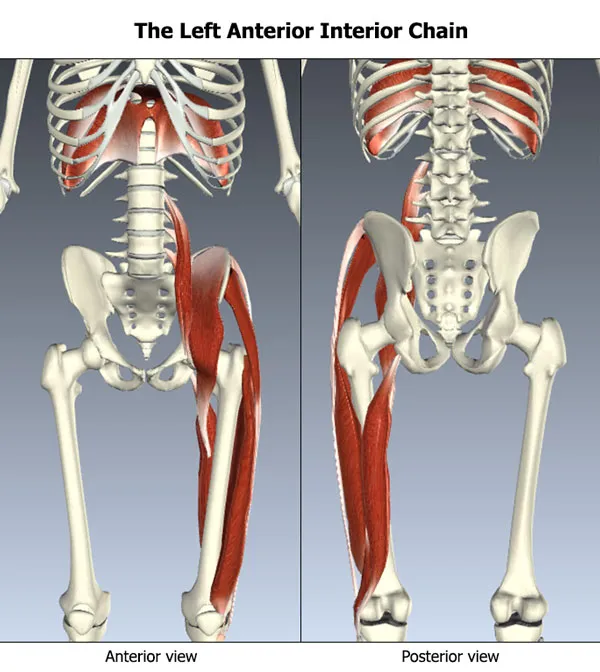
Pelvis Restoration exam preparation.
Joints are passive structures. They permit motion; they do not produce it. Muscles produce motion. At any joint, both bones move relative to each other — which one moves more depends on loading, not on the joint itself. There is no inherent "mover" and "fixed bone."
PRI's naming system departs from this. Each acronym (IS, SI, IP, IsP, AF, FA) names a joint by putting one bone first — declaring it the reference point for treatment. IS and SI are the same sacroiliac joint. AF and FA are the same hip joint. The first letter tells you which bone PRI wants you to influence; the second letter is the bone it moves relative to. IR/ER names the direction.
This is treatment-planning shorthand, not biomechanical description. The acronyms encode three things in one label: anatomy (which bones), a clinical frame (which muscle group to facilitate), and position (IR or ER). If you read them as literal mechanics — one bone moves, the other stays put — they will not make sense, because that is not how joints work.
The Translation Table maps every PRI term to its standard anatomical equivalent with this logic explained.
The pelvis contains five joints. PRI's position-naming system references three of them — the sacroiliac joint, the pubic symphysis, and the hip joint. The other two (lumbosacral and sacrococcygeal) are anatomically present but excluded from PRI's framework because they do not involve innominate displacement.
| Joint | Type | Motion | PRI Positions | PRI Role |
|---|
PRI's 12 position codes reference exactly 3 joints. The naming convention encodes which bone is displaced and which to target — not the joint itself. IS and SI are the same physical joint (sacroiliac). AF and FA are the same physical joint (hip). IP and IsP reference the same landmark (pubic symphysis). Six joint names, three anatomical structures.
Sacroiliac joint
Hip joint (acetabulofemoral)
Reading PRI acronyms: the first letter names the bone PRI considers the reference point for treatment. The second letter names the bone it moves relative to. IR/ER names the direction.
| Acronym | Decode | Meaning |
|---|---|---|
| IS | Ilio-Sacral | Ilium relative to sacrum — posterior inlet. Target: muscles that move the ilium. |
| SI | Sacro-Iliac | Sacrum relative to ilium — posterior outlet. Same joint as IS. Target: muscles that move the sacrum. |
| IP | Ilio-Pubo | Ilium relative to pubic symphysis — anterior inlet. Target: muscles that tilt the ilium. |
| IsP | Ischio-Pubo | Ischium relative to pubic symphysis — anterior outlet. Target: muscles that move the ischium. |
| AF | Acetabulo-Femoral | Pelvis on femur — closed chain (stance leg). Target: reposition pelvis over planted femur. |
| FA | Femoro-Acetabular | Femur on pelvis — open chain (swing leg). Target: mobilize femur in the socket. |
These are treatment-planning codes, not anatomical terms. The same physical joint gets two names to encode which muscle group to facilitate.
PRI creates new joint names to encode treatment targets. IS vs. SI is the same sacroiliac joint — the name tells you which bone PRI considers displaced. IP and IsP describe innominate movement relative to the pubic symphysis — a real joint (amphiarthrosis) with minimal motion that PRI uses as a positional reference, not a treatment target.
| PRI Term | Real Structure | What PRI Renamed | What Actually Happened | Standard Term | Encoded Treatment Target |
|---|
= — differentiating tests between patterns.
Click a node to highlight its connections.
| Test | Left AIC | Bilateral PEC | B Patho PEC |
|---|---|---|---|
| ADT | + Left only | + Bilateral | + Bilateral |
| PADT | + Left only | + Bilateral | + Bilateral |
| PART | + Right | − Bilateral | + Bilateral or unilateral |
| SRT | > 0" (L hip shift) | > 0" (can't touch toes) | = 0" (touches toes) |
| Squat | < 3/5 | < 3/5 | > 3/5 |
| HALT | R 0-4/5 | Low bilaterally | Low bilaterally |
Drag (or tap) to reorder the steps in each causal chain. Click "Check" when done.